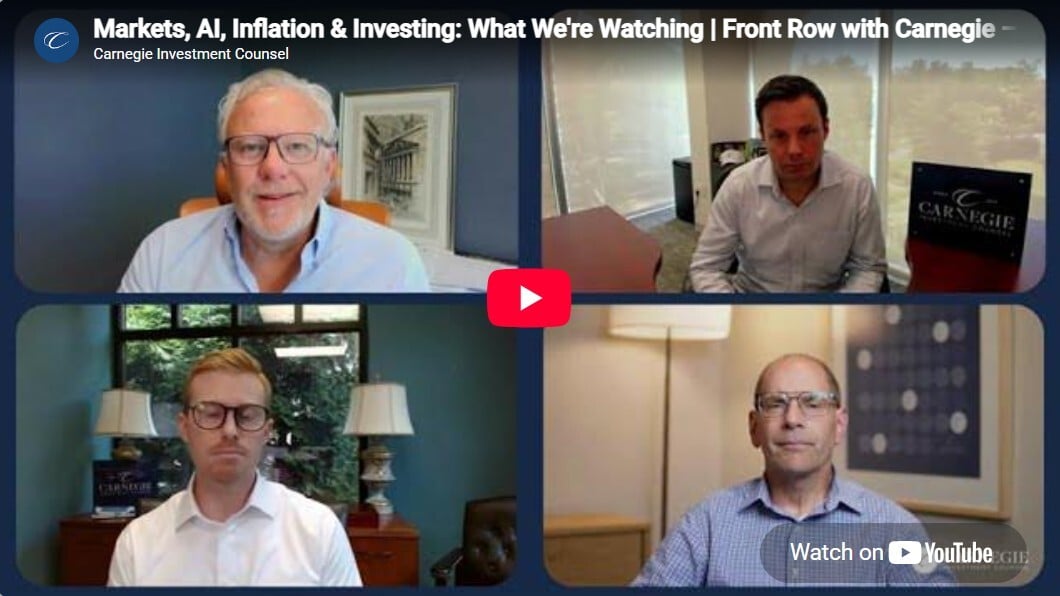
As 2026 draws to a close, investors are facing some important questions. How will higher interest rates affect stocks and bonds? Are artificial intelligence companies living up to their valuations? And could the index funds many investors rely on be exposing them to more risk than they realize?
In this edition of Front Row with Carnegie, our investment and financial planning professionals discuss these questions, along with year-end planning opportunities that could make a difference in your financial picture. Below are some of the key takeaways from the conversation, or you can watch the full discussion in the video below.
Read More
Topics:
Investing,
Financial Planning,
Market,
Economy,
Interest Rates
Fall means cooler weather, changing leaves, and for investors it's another earnings season. Between the Fed's new rate-hike cycle, Big Tech's ongoing AI spending spree, and consumers gearing up for the holidays, there's a lot to watch this month.
At Carnegie Investment Counsel, we're focused on three things: what companies are actually getting for their AI investments, how healthy the consumer really is, and whether rising energy prices start feeding back into inflation.
Read More
Topics:
Investing,
Market,
Economy
Semiconductor stocks were the story of the first half of 2026. The NYSE Semiconductor Index was up 114% through June 30. The index's top holdings include Nvidia, Micron, Advanced Micro Devices, Broadcom and Intel.
So far, the third quarter has been a very different story. As of September 3, the index was down 22% for the quarter. Despite that decline, it remains up 67% for the year.
Interestingly, the decline in the index has not been driven by weakness in the underlying earnings of the companies. In fact, the major semiconductor companies have generally reported very strong results.
Read More
Topics:
Stocks,
Market,
Economy
As we head into September, the investment team at Carnegie continues to monitor key data that will impact market conditions. Interest rates remain elevated; inflation continues to be a concern, and the enormous investment behind artificial intelligence is creating opportunities as well as risks. At the same time, the strength of the consumer is becoming more difficult to assess, and markets continue to rotate beneath the surface.
Against that backdrop our focus remains on understanding what is driving portfolio performance, maintaining diversification and being selective about where we take risk.
Read More
Topics:
Investing,
Market,
Economy
The bond market has been making headlines recently as long-term Treasury yields have risen to levels last experienced in 2007. This has generated concerns about inflation, government borrowing, and the potential impact of higher interest rates on both bonds and stocks.
Read More
Topics:
Stocks,
Market,
Economy
The first half of 2026 gave investors plenty to digest. Artificial intelligence continued to dominate headlines, market leadership shifted beyond the Magnificent Seven, the Federal Reserve remained focused on inflation, and ongoing tariff and geopolitical developments added new layers of uncertainty.
In this edition of Front Row with Carnegie, our investment and financial planning professionals discuss the trends shaping today's markets, what they're watching for in the months ahead, and how those developments may affect long-term investors. Below are some of the key takeaways from the conversation, or you can watch the full discussion in the video below.
Read More
Topics:
Investing,
Financial Planning,
Stocks,
Market,
Economy
August tends to be a time when market activity can grow harder to analyze. Trading desks thin out, news flow slows, and short-term momentum can swing prices more than fundamentals do. Still, the month gives investors plenty to watch, including corporate earnings and Fed policy, to signs that market leadership may be broadening beyond artificial intelligence.
Read More
Topics:
Investing,
Market,
Economy
One of the most common questions investors ask is why a great company can report strong earnings and still see its stock price fall sharply. The answer often comes down to one word: expectations.
Over the long run, earnings growth is the primary driver of a company's stock price. However, in the short run, changes in investors' expectations about future growth can have an even greater impact. Understanding this relationship helps explain why some of the market's fastest growing companies can also be among its most volatile.
Read More
Topics:
Investing,
Stocks,
Market,
Volatility,
Investment Management
As we approach mid-summer, investors find themselves navigating two powerful forces: excitement and expectations. From headline-grabbing IPOs to the continued enthusiasm surrounding artificial intelligence (“AI”), markets are once again being shaped by a combination of innovation, optimism, and speculation. While these themes have helped propel stocks higher, they also serve as a reminder of an enduring investing principle: enthusiasm alone is not a substitute for fundamentals.
In our July commentary, we want to devote time examining the surge in mega-cap IPO activity, what earnings season may reveal about AI-related valuations, the evolving interest rate landscape, and where opportunities may exist beyond the technology sector.
Read More
Topics:
Investing,
Market,
Economy
As we move into the summer months, investors continue to navigate a market environment shaped by rapid technological change, geopolitical uncertainty, and shifting economic expectations. While markets have remained resilient beneath the surface, there are growing signs that investors should remain thoughtful and disciplined in how they approach risk and opportunity in the second half of the year.
This month we examine the growing concentration around artificial intelligence investments, the evolving interest rate outlook, the changing consumer landscape, and what the current economic environment may mean for younger workers entering the labor force.
Read More
Topics:
Investing,
Market,
Economy


.png)
.png)
.png)
.png)
-1.png)
.png)