
From corporate earnings and rising interest rates to the November midterm elections, there is no shortage of developments keeping the investment team at Carnegie Investment Counsel on its toes. As we enter the final months of 2026, investors are navigating a market shaped by resilient consumer spending, persistent inflationary pressures and the rapid evolution of artificial intelligence (AI). With AI continuing to dominate market headlines, we're also looking beyond the technology sector to identify opportunities across the broader economy.
With plenty of moving parts in the market, we're closely monitoring these developments while keeping our focus on long-term investment opportunities. Here's a closer look at the key trends and events we're watching as we approach year-end.
What We’re Watching in November
Earnings Season: The Consumer Remains Resilient
Third-quarter earnings season is offering important insight into the health of the economy. Reports from major banks suggest that consumers remain resilient, supported by an unemployment rate just above 4.2%. Despite persistently low consumer sentiment, Americans continue to spend, reinforcing the importance of employment in supporting economic growth.
We're paying particularly close attention to consumer discretionary companies and their expectations for the holiday shopping season. Many consumer names have faced pressure in the market this year despite delivering strong operating results.
The question now is whether consumer spending can maintain its momentum amid higher energy prices and ongoing inflation. With the holiday season representing a critical period for many retailers, management commentary on spending trends, pricing strategies and profit margins will determine expectations heading into 2027.
Inflation and Interest Rates: A Balancing Act for the Fed
Inflation remains a concern as recent Consumer Price Index (CPI) and Producer Price Index (PPI) reports have come in higher than expected. Rising energy costs are adding to these pressures, with high gasoline and diesel prices affecting both consumers and businesses.
For companies that rely on transportation and distribution, higher fuel costs can create a difficult choice: pass those expenses along to customers or absorb them at the expense of profit margins. Either approach can have implications for earnings, particularly in consumer-facing industries.
The challenge for the Fed is finding the right balance between slowing inflation and avoiding excessive tightening that could weigh on economic growth.
Higher borrowing costs are also becoming an increasingly important consideration for businesses, particularly those financing large infrastructure projects. This brings us to one of the market's biggest themes: the continued expansion of AI.
Beyond the AI Boom: Opportunities Across the Market
While AI continues to dominate headlines, we're also finding opportunities in other sectors of the market. Healthcare and consumer discretionary companies remain areas of interest, particularly as some have experienced significant share price declines despite strong underlying fundamentals and resilient consumer spending.
We're also watching companies involved in modernizing the nation's electrical grid, as demand for power continues to grow beyond AI. Meanwhile, select software companies may present opportunities as concerns about AI disruption have weighed on valuations.
As always, our focus remains on identifying high-quality businesses with attractive long-term growth potential.
Chart of the Month:
Midterm Elections: Looking Beyond the Headlines
The results of the November midterm elections could have an important impact on investor behavior.
Historically, markets tend to dislike uncertainty more than any particular political outcome. Once election results are known, investors can begin assessing the policy environment with greater clarity.
Although shifts in congressional control may influence the legislative agenda, divided government can also limit the likelihood of sweeping policy changes. In many cases, markets have responded favorably to this type of political gridlock because it provides a measure of predictability.
While the election may create some short-term volatility, we don't believe investors should make significant portfolio changes based solely on anticipated political outcomes.
Ultimately, corporate earnings, interest rates and economic fundamentals remain more important drivers of long-term market performance. The chart below shows the S&P 500 Index tends to track the movement of the earnings per share (EPS) of the companies included in the Index. Elections can create short-term volatility but earnings drive the market.
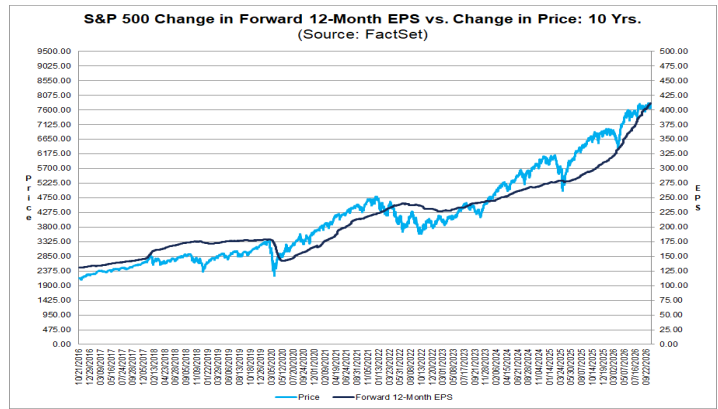
Source: FactSet, Earnings Insight, October 23, 2026.
Final Thoughts
The market presents a combination of meaningful opportunities and evolving risks. Consumers continue to demonstrate resilience, infrastructure investment remains substantial and technological innovation is creating new possibilities across industries.
If there's one takeaway from the current environment, it's that the pace of change is accelerating. What appears to be a competitive advantage today can shift quickly, particularly in industries being transformed by artificial intelligence.
At Carnegie Investment Counsel, our focus remains on separating short-term market noise from long-term investment fundamentals. By maintaining a disciplined, diversified approach and continually evaluating new opportunities, we aim to help our clients navigate changing market conditions with confidence.
As always, we're here to help you stay informed and focused on achieving your long-term financial goals.
This commentary is for informational purposes only and includes general economic and market conditions. Forward-looking statements cannot be guaranteed. Past performance is not a guarantee of future results. Data and other market and economic information referenced is from sources believed to be reliable and opinions are subject to change. All investments involve risks, including the loss of principal.
Carnegie Investment Counsel (“Carnegie”) is a registered investment adviser under the Investment Advisers Act of 1940. Registration as an investment adviser does not imply a certain level of skill or training. For a more detailed discussion about Carnegie’s investment advisory services and fees, please view our Form ADV and Form CRS by visiting: https://adviserinfo.sec.gov/firm/summary/150488.
You may also visit our website at: https://www.carnegieinvest.com.