
As we embark on 2026, we at Carnegie reflect on a resilient 2025 that saw the S&P 500 deliver solid gains amid headwinds such as tariffs and government budget cutbacks. The market tested many investors through sharp headlines portraying market news and pullbacks as dramatic declines, such as "Dow plummets 500 points," often representing less than 1% moves.
Our take? Headline-driven commentary is designed to elicit an emotional response (to drive clicks!), but it is often the best time to remember your time horizon. Over longer horizons of 1, 5, or 10 years, these fluctuations pale in comparison to the power of compounding in quality investments. At Carnegie, we remain focused on identifying continual compounders striving to build wealth steadily through economic cycles.
As we enter 2026, maintaining discipline amid noise remains key, emphasizing long-term horizons over reactionary moves. Below, we share a few larger themes we are watching as we turn the page on 2025.
What We’re Watching in January
Broadening Market Leadership
Towards the end of 2025, the dominance of the "Magnificent 7" tech giants showed signs of slowing down, particularly in December, where sectors like energy, healthcare, and utilities delivered strong performance. While it remains to be seen how these tech-heavy names perform in a year that will undoubtedly be focused on AI investment, this rotation reflects healthier market dynamics, reducing reliance on a handful of stocks and signaling potential for wider participation in 2026 gains.
Software to Hardware: AI’s Story to Watch
With regards to AI investments, 2026 may mark an inflection point for robotics and autonomous technologies, akin to the iPhone's transformation from novelty to a part of our daily life. Much of 2025 was focused on the software side of AI, like ChatGPT-like tools. Advances in AI hardware are accelerating deployments, with companies like Tesla advancing its Optimus humanoid robot and Full Self-Driving capabilities, Waymo (Owned by Google/Alphabet) expanding robotaxi services across multiple cities, Uber integrating autonomous fleets, and Amazon leveraging robotics in logistics and within its warehouses. These innovations promise productivity gains but warrant monitoring for adoption timelines, regulatory hurdles, and long-term success.
IPO Market Revival and Capital Access
After somewhat of a rebound in 2025, the IPO market enters 2026 with momentum, featuring potential high-profile listings including SpaceX, Anthropic, Databricks, Cerebras and even OpenAI. This comes after an increase in activity in Q3 and Q4 of 2025, despite prior pauses earlier in the year. A rising number of offerings support capital formation, countering the long-term decline in public companies through mergers and buyouts. While we focus on companies that generally show strong fundamentals over sustained periods, the IPO market can signal a robust capital markets system that supports the overall economy and may provide opportunities for growth-oriented investors.
Federal Reserve Outlook and Policy Transitions
As 2026 begins, the Federal Reserve is navigating a delicate balance between further monetary easing and maintaining inflation credibility. After several rate cuts that brought the federal funds rate to the 3.50%–3.75% range, officials and market forecasts suggest a pause early in the year, with the potential for additional cuts later depending on inflation and labor market data. Inflation remains above the Fed’s 2% target but is trending lower, supporting a cautious easing stance without undermining price stability.
At the same time, the pending transition in leadership, with Jerome Powell’s term ending and potential successors under consideration, adds a layer of uncertainty. While some candidates are perceived as more dovish, there’s also clear division within the Fed on how quickly and how far to ease policy, reinforcing that decisions will remain highly data-dependent throughout 2026.
The Power of Compounding: A Nonpartisan Reminder to Start Early
The recent spotlight on “Trump Accounts” is a useful reminder, regardless of political views, which starting early is one of the most powerful wealth-building tools available. Under the program, eligible children (born 2025–2028) may receive a $1,000 government seed contribution, and families can add up to $5,000 per year, creating a long runway for compounding over decades.
The initiative has also attracted major private support, including a $6.25 billion commitment from Michael and Susan Dell and a pledge from Ray Dalio aimed at supporting children’s accounts at scale, alongside early employer participation such as matching programs announced by BlackRock and Chime.
While these accounts are one way to encourage long-term investing, they also reinforce a broader planning point: there are many smart ways to save for children and grandchildren — including more traditional tax-advantaged tools like 529 plans — and the best approach depends on a family’s goals and time horizon. Carnegie’s team is always available to start the discussion on planning for your family’s future.
Why Tariffs Stole Headlines in 2025
While tariffs rarely dominate headlines for long, their impact can surface gradually through pricing pressure and volatility. For investors, understanding these dynamics helps explain short-term market moves and reinforces the importance of diversification amid policy-driven uncertainty.
This chart highlights why trade policy remains an important undercurrent for markets. Shifts in effective tariff rates influence inflation, corporate input costs, and profit margins, with downstream effects on earnings, interest rates, and market leadership
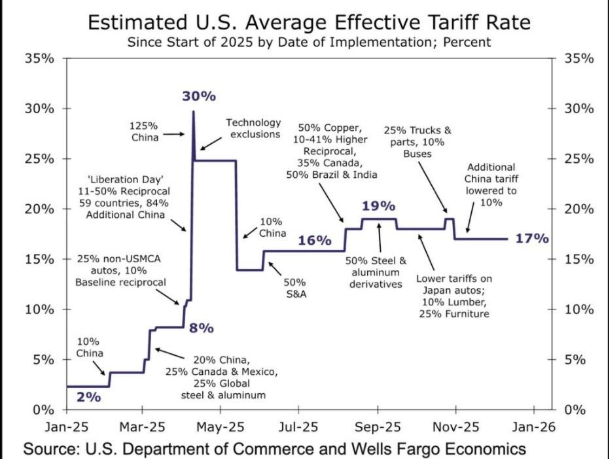
Chart of the Month
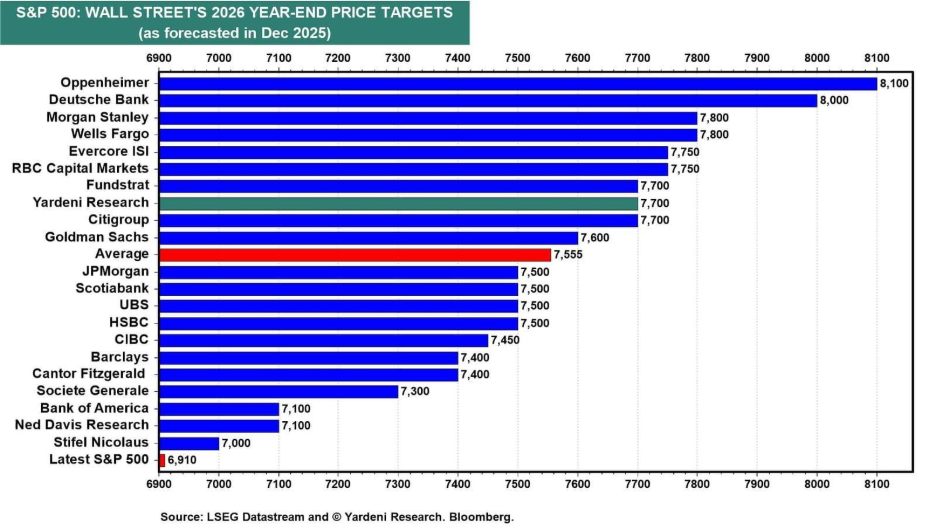
Wall Street Strategists' 2026 S&P 500 Forecasts
Wall Street forecasts for year-end 2026 S&P 500 levels cluster around 7,500-8,000, with optimistic calls reaching ~8,200 from firms like Oppenheimer and Deutsche Bank, reflecting expectations for mid-teens growth. Current levels hover near 6,800, implying significant potential upside. Notably, nearly all strategists anticipate gains, with only one projecting a down year, reinforcing our view that quality, diversified exposure positions portfolios for long-term success amid varying outcomes.
Final Thoughts
The dawn of 2026 brings reflection on enduring principles amid evolving themes—from AI advancements and policy shifts to new savings vehicles. Carnegie remains dedicated to navigating these dynamics alongside you, tailoring strategies to your goals. Please reach out to discuss how these trends may impact your portfolio. Here's to a prosperous year ahead.
With 2025's positive close and a bullish analyst consensus for 2026, optimism abounds, yet historical patterns remind us that extended rallies often invite moderation through valuation or unforeseen events. Diversification, strategic allocation, and a focus on fundamentals remain essential.
This commentary is for informational purposes only and includes general economic and market conditions. Forward-looking statements cannot be guaranteed. Past performance is not a guarantee of future results. Data and other market and economic information referenced is from sources believed to be reliable and opinions are subject to change. All investments involve risks, including the loss of principal.
Carnegie Investment Counsel (“Carnegie”) is a registered investment adviser under the Investment Advisers Act of 1940. Registration as an investment adviser does not imply a certain level of skill or training. For a more detailed discussion about Carnegie’s investment advisory services and fees, please view our Form ADV and Form CRS by visiting: https://adviserinfo.sec.gov/firm/summary/150488.
You may also visit our website at: https://www.carnegieinvest.com.