What We're Watching in December
With only a month to go before the end of 2025, the financial markets experienced unexpected twists and turns that many didn’t expect during the year. Seasonal trends were cast out the window, economic signals sent mixed messages, and the promise of an AI boom was continually met with skepticism. In the face of this, we at Carnegie continue to focus on clarity, balance, and long-term discipline. From Fed policy and AI spending to the real story behind inflation, here’s what we’re watching closely as the year draws to a close.
AI Fatigue or Financial Fiction?
One trend that drew huge individual interest this year was the prediction markets, such as Polymarket or Kalshi. Though we don’t follow the data closely on these sites, as they grow in popularity these markets will inevitably be something that we’ll watch more closely in 2026. If you check out Polymarket right now, you’ll see that in the category of “Time Person of the Year for 2025”, not one real person is leading the race, but rather the category of “Artificial Intelligence” is the consensus choice to take home the prize. This goes to show that AI has become such a ubiquitous force in the public’s consciousness.
Much has been made about AI and all the hopes and dreams that follow. Many investors are expecting it to be the catalyst for US and global economic growth for many years to come. Yet, underlying AI’s hope, one conversation this month that has stirred many headlines was a fire lit by investor Michael Burry of “The Big Short,” who accused major AI players of fabricating earnings by stretching depreciation schedules.
His belief is that AI companies are depreciating products over 5, 6 or 7 years instead of 2–3, artificially lifting earnings. However, Nvidia’s CEO pointed to their A100 GPU in full use for 6 years as evidence that the lifespan argument doesn’t hold water.
We believe it is healthy to question stretched valuations and breakneck spending. When five firms are investing as much as entire countries, it’s wise to remain skeptical. But AI leaders like Nvidia, Microsoft, and Amazon have a lot of cash. Unlike 1999 dot-com hopefuls. We continue to own these names across portfolios, but our eyes are open to risk, especially around capital intensity and future return on investment.
Jobs, Revisions, and the Fed’s Path
Employment numbers have been anything but straightforward. August was revised down from +22,000 to –4,000, a sharp shift. September came in at 119,000 but is likely overstated too. These revisions have a real impact. If softness persists, the Fed may be pushed to accelerate rate cuts in early 2026.
The December 9–10th Fed meeting will be pivotal. With October jobs data delayed and September’s revision due after the meeting, the Fed will be flying partially blind, or as they have said, in the fog. As of now, two cuts have already occurred. A third could arrive sooner than expected if the labor market continues to deteriorate.
A Housing Market of Firsts: Incentives, 50-Year Loans, and a Pricing Shift
For the first time in this cycle, new homes are cheaper than existing ones in many regions, thanks to aggressive builder incentives. This is providing rare opportunities for first-time buyers. For those watching the news headlines, the idea of the 50-year mortgage has been proposed by the White House. The debate around these ultra-long loans has become spirited. While some see them as useful arrows in the affordability quiver, others caution that they may simply delay, rather than reduce, the financial burden. Ultimately, the real solution lies in increasing supply, not extending debt timelines.
Black Friday and the Elusive “Santa Rally”
Consumer sentiment remains surprisingly resilient. Walmart posted 4.5% same-store sales growth in November, not small for a company of its size. That kind of strength suggests the holiday season may finish on solid footing.
But from a market standpoint, 2025 has flipped traditional seasonality on its head. May, usually quiet, was spectacular. September and October, often weak, posted gains. And now, in what’s typically a strong stretch, the Nasdaq is down roughly 5%. This isn’t the season to bet on patterns. It's the season to stay flexible.
The “Two Economies” and What’s Personal Inflation
This year gauging inflation’s impact posed a conundrum for many market participants. Headline inflation is one thing. Your personal experience with inflation is another.
That was a recurring theme in our team’s recent discussion that inflation impacts everyone differently. If you don’t have kids in college, tuition inflation doesn’t hit home. If you’re renting or buying groceries, that’s your reality. The government gives us one number, but your personal economy may look very different.
Meanwhile, broader inflation pressures seem to be easing. Business cost expectations are at their lowest since January, rents are softening, and tariffs, at one time feared to be inflationary, may actually be having a deflationary effect by destroying demand.
Chart of the Month
Business Inflation Expectations Revert
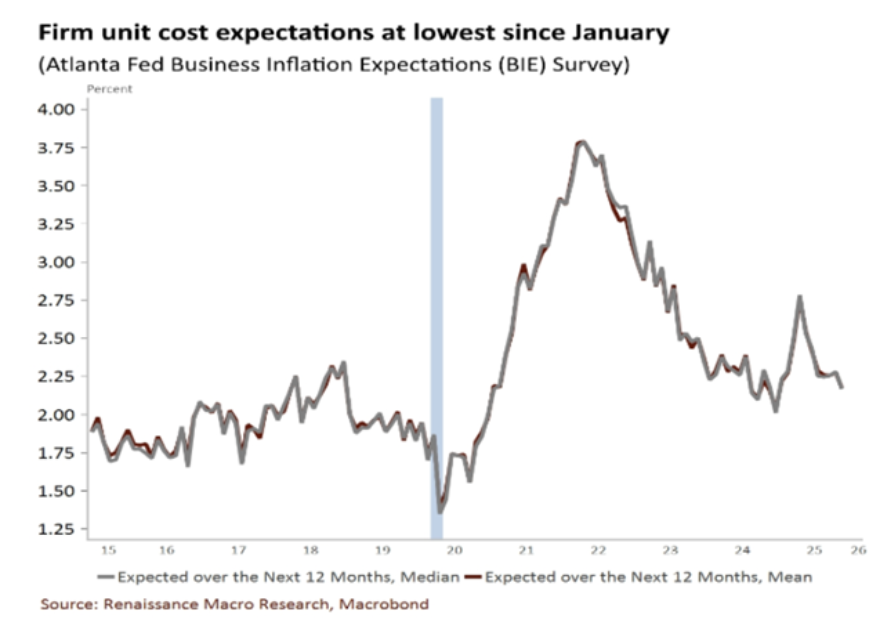
Our chart for December highlights a surprising shift. Businesses’ inflation expectations have returned to pre-tariff levels. Despite higher input costs and policy uncertainty, firms don’t anticipate large price hikes ahead. For investors, that suggests inflation may remain manageable and the Fed might regain some flexibility heading into 2026.
Final Thoughts
As we end the year with mixed signals and wildly different market outcomes that many expected, the market has both frustrated and given hope to investors at different times during the year. But through the noise, a few truths are clear. AI is real, but so is the fatigue from overhyped promises in this technological revolution that many are expecting to happen overnight. With that in mind, it is critical to know what you own. Rate cuts are coming, but policy visibility remains limited. Inflation may be less threatening, but no less personal.
In investing, as in life, resilience matters more than prediction. From everyone at Carnegie Investment Counsel, thank you for your continued trust. We’re honored to be your financial guide and look forward to helping you navigate the road ahead in 2026 and beyond.
This commentary is for informational and educational purposes only and includes general economic and market conditions. Forward-looking statements cannot be guaranteed. Past performance is not a guarantee of future results. Data and other market and economic information referenced are from sources believed to be reliable, and opinions are subject to change. All investments involve risks, including the loss of principal.
Carnegie Investment Counsel (“Carnegie”) is a registered investment adviser under the Investment Advisers Act of 1940. Registration as an investment adviser does not imply a certain level of skill or training. For a more detailed discussion about Carnegie’s investment advisory services and fees, please view our Form ADV and Form CRS by visiting: https://adviserinfo.sec.gov/firm/summary/150488.
You may also visit our website at: https://www.carnegieinvest.com.