
As we move into April, several familiar forces are converging at once. Tax season is coming to a close, earnings season is set to begin, and renewed geopolitical tensions are influencing markets — most visibly through energy prices. While these may appear to be separate headlines, they are interconnected parts of a broader environment the market is working to process. This is typical for this time of year: periods of short-term uncertainty often emerge even as the underlying, longer-term foundation remains more stable than the headlines suggest.
What We’re Watching in April
Taxes and Planning: Don’t Miss the Simple Wins
April naturally puts taxes front and center, but beyond the filing deadline, it’s also a good moment to revisit the basics. Contribution limits change, rules get updated, and it’s easy to overlook opportunities that can quietly make a meaningful difference over time. Making sure you’re taking full advantage of accounts like 401(k)s, IRAs, and HSAs isn’t complicated, but it is important. These decisions don’t feel urgent in the moment, yet they tend to be the ones that compound most effectively over the long run. More often than not, it’s the simple, consistent actions that end up doing the heavy lifting.
Geopolitics and Energy: It’s Not Just Gas Prices
Military action in the Middle East, particularly involving Iran, has pushed energy back into focus. Most people feel that first at the gas pump, but that’s really just the starting point. Energy flows through almost every part of the economy. It impacts transportation, manufacturing, plastics, and even food production. Fertilizer, for example, relies heavily on natural gas, and while prices in the U.S. may look stable, higher costs elsewhere can still ripple through global markets and show up in everyday expenses.
There are also second-order effects that tend to take longer to appear. Key shipping routes like the Strait of Hormuz are critical not just for oil, but for materials tied to semiconductors and industrial production. When disruptions occur, they don’t hit all at once, but over time they work their way into supply chains, pricing, and ultimately company earnings. That’s often how these situations unfold. What starts as a headline gradually becomes part of the broader economic backdrop.
Market Volatility: Staying Invested Through It
This kind of environment tends to bring more volatility, and that’s what we’ve been seeing across both stocks and bonds. Rising yields have put pressure on fixed income, while equities continue to adjust to shifting expectations. It’s not always comfortable, but it’s also not unusual. Markets rarely move in straight lines, and periods like this are part of the process. The bigger risk tends to come from reacting too quickly rather than staying disciplined. Missing even a handful of the market’s strongest days can have a lasting impact on long-term results, which is why remaining invested while being selective continues to matter. From our perspective, that means focusing on high-quality companies, taking advantage of pullbacks where appropriate, and trimming positions that have gotten ahead of themselves.
Earnings Season: What We’re Watching
April also marks the start of earnings season, with the large banks typically leading the way. These early reports tend to give a good sense of how the consumer is holding up, and so far, the picture remains fairly steady. There’s a lot of cautious sentiment, but when you look at actual behavior, spending has held up better than expected.
Part of that story is the amount of wealth still sitting in the system, particularly among older generations, where assets across stocks, bonds, and real estate remain significant. As earnings calls unfold, the focus will be on how companies are handling higher costs, whether they’re still able to pass those costs along, and how confident they are in their outlooks. One area that continues to stand out is artificial intelligence, which remains one of the few parts of the economy where investment is clearly moving higher.
Private Credit: Proceed Carefully
One area where our view remains straightforward is private credit. It’s getting a lot of attention, largely because of the yields being offered, but those returns often come with trade-offs, particularly around liquidity. In many cases, capital is tied up, and getting it back isn’t always easy, especially if conditions change. We’ve also seen an increase in how frequently these types of investments are being marketed, which historically tends to happen later in cycles. For us, the conclusion hasn’t changed. It’s an area where caution is warranted.
Richard Alt, CEO, shared his thoughts on this in our recent Carnegie Counselor.
Chart of the Month
A Quiet Tailwind
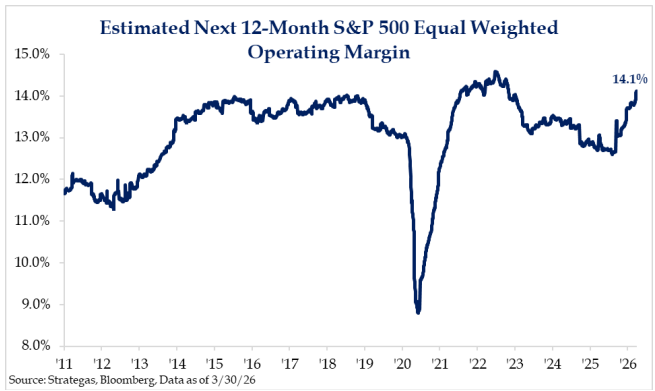
This month’s chart highlights a longer-term trend that doesn’t always get the attention it deserves: productivity and corporate margins. If you step back, margins have generally trended higher over time. Not in a straight line, but with a clear upward bias. Companies have become more efficient, more adaptable, and better at navigating changing environments. Technology has been a big driver of that trend, and AI has the potential to push it even further. While inflation and rising costs tend to dominate the conversation, productivity gains are helping offset some of that pressure. It’s a quieter force, but an important one, and a reminder that not all of the underlying trends are working against the market.
Final Thoughts
April brings a little bit of everything. From taxes, earnings, geopolitics, and questions around the Fed, that can feel like a lot, but the core approach remains the same. Stay disciplined, focus on quality, and keep a long-term perspective. Markets will always give you reasons to react. More often than not, the better approach is to stay steady and let time do the work. As always, we’re here to help guide you through it.
This commentary is for informational purposes only and includes general economic and market conditions. Forward-looking statements cannot be guaranteed. Past performance is not a guarantee of future results. Data and other market and economic information referenced is from sources believed to be reliable and opinions are subject to change. All investments involve risks, including the loss of principal.
Carnegie Investment Counsel (“Carnegie”) is a registered investment adviser under the Investment Advisers Act of 1940. Registration as an investment adviser does not imply a certain level of skill or training. For a more detailed discussion about Carnegie’s investment advisory services and fees, please view our Form ADV and Form CRS by visiting: https://adviserinfo.sec.gov/firm/summary/150488.
You may also visit our website at: https://www.carnegieinvest.com.