One of the most common questions investors ask is why a great company can report strong earnings and still see its stock price fall sharply. The answer often comes down to one word: expectations.
Over the long run, earnings growth is the primary driver of a company's stock price. However, in the short run, changes in investors' expectations about future growth can have an even greater impact. Understanding this relationship helps explain why some of the market's fastest growing companies can also be among its most volatile.
.png?width=737&height=553&name=Carnegie%20Blog%20Post%20Header%20Template%20(37).png)
Earnings Growth Drives Long-Term Returns
Let's begin with a simple example.
Assume a company consistently trades at 20 times trailing earnings (20x P/E) and pays no dividend.
If the company earned $5.00 per share over the past year, its stock would trade at:
$5.00 × 20 = $100 per share
Now suppose earnings grow by 10% during the year to $5.50 per share. If investors continue valuing the company at 20x earnings, the stock price becomes:
$5.50 × 20 = $110 per share
In this simplified example, earnings increased by 10%, and the stock appreciated 10%. Over long periods, this relationship between earnings growth and stock performance is fairly consistent.
Valuation Depends on Expectations
Real markets, however, are rarely this straightforward.
The price investors are willing to pay for each dollar of earnings, i.e. the P/E multiple, is constantly changing based on expectations about the future.
When investors believe earnings growth is accelerating, they typically pay a higher multiple. When they expect growth to slow, that multiple contracts.
Just as important as the growth rate is the consistency of that growth.
Imagine two companies that both compound earnings at an annual rate of 5%.
- Company A grows earnings steadily by 5% every year.
- Company B experiences years of 0% growth followed by years of 10% growth.
Although their average growth rates are identical, investors generally assign a higher valuation to Company A because its earnings are more predictable. Markets tend to reward consistency.
This principle can be seen across sectors.
Utilities often generate relatively modest earnings growth but trade at comparatively high valuation multiples because their earnings are stable and predictable. By contrast, materials companies can experience higher average growth over the long-term but often receive lower valuation multiples because their earnings are far more cyclical.
Why Faster Growth Commands Higher Valuations
Now consider two companies with different estimated growth rates over the next five years.
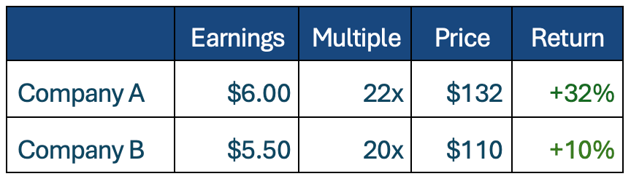
Both companies earned $5.00 per share in the previous year and trade at $100 per share (a 20x earnings multiple). Company A is expected to grow earnings by 20% annually for the next five years, while Company B is expected to grow earnings by 10% annually.
For example, after a year of 20% growth, Company A’s earnings would be $6.00 per share. The stock may also trade at 22x earnings, bringing the price to $132, for a total return of 32%. Company B, with its 10% earnings growth and constant 20x multiple would increase to $110 for a 10% return.
Expectations Can Continue to Expand
Valuation expansion often feeds on itself.
Suppose investors initially believe Company A can sustain 20% growth for five years before growth moderates. If early results exceed expectations, investors may conclude that this high-growth period could last even longer.
Without any change in current earnings, the stock price can rise simply because the market extends its forecast of future growth. This dynamic explains why companies can become increasingly expensive during periods of strong execution.
As long as expectations continue improving, higher valuation multiples can be justified.
The Danger of High Expectations
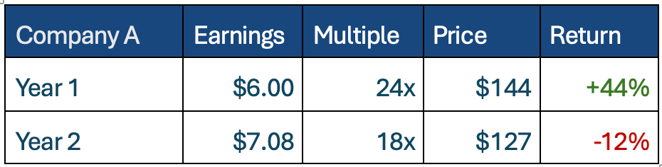
Eventually, however, expectations can become overly optimistic, as the below illustration for Company A shows:
Imagine investors begin expecting earnings in five years to reach $13 per share instead of over $12. That's only a modest increase in the expected growth rate—from roughly 20% to 21% annually—but it also boosts investor confidence enough to increase the valuation multiple from 20x to 24x. The total return in Year 1 jumps even more to 44%!
Now consider the opposite scenario a year later.
Suppose investors revise their forecast downward. Instead of earning $13.00 in four years, they now expect $11.50 per share. That's still an impressive 18% annual growth rate, yet investors become less certain about the company's long-term outlook and are weary of even slower growth. Perhaps Company A is losing share to Company B and its multiple contracts below 20x.
As confidence fades, the valuation multiple falls from 24x to 18x and the stock declines 12% to $127 in Year 2, even though the company is still expected to deliver exceptional long-term earnings growth.
Why Companies Can Be So Volatile
This is the key lesson for investors.
Stocks don't simply react to whether earnings beat or miss expectations. They react to changes in the market's assumptions about the future.
When expectations are already extremely high, even a small disappointment can trigger a significant decline because investors simultaneously reduce both their earnings forecasts and the valuation multiple they're willing to pay.
Conversely, companies with modest expectations often experience strong stock performance when they merely perform a little better than anticipated.
The Bottom Line
High-growth companies deserve premium valuations because future earnings are expected to be substantially larger. But those premium valuations also leave little room for disappointment.
When expectations become elevated, relatively small changes in growth assumptions can produce outsized swings in stock prices.
That's why some of the market's fastest-growing businesses can also be its most volatile investments.
For long-term investors, understanding the distinction between business performance and market expectations is essential. Companies can remain great businesses and still experience sharp corrections due to changing expectations. Confidence in the long-term trajectory is the most important part of any investment.
For informational purposes only. The information is not intended to provide specific advice or recommendations, and all investments involve risks, including the loss of principal.
Carnegie Investment Counsel (“Carnegie”) is a registered investment adviser with the Securities and Exchange Commission. Registration as an investment adviser does not imply a certain level of skill or training. For a more detailed discussion about Carnegie’s investment advisory services and fees, please view our Form ADV and Form CRS by visiting: https://adviserinfo.sec.gov/firm/summary/150488.
You may also visit our website at: https://www.carnegieinvest.com.