
The bond market has been making headlines recently as long-term Treasury yields have risen to levels last experienced in 2007. This has generated concerns about inflation, government borrowing, and the potential impact of higher interest rates on both bonds and stocks.
.png?width=737&height=553&name=Carnegie%20Blog%20Post%20Header%20Template%20(44).png)
Stepping back from the headlines provides a more nuanced picture. Today's bond market is not necessarily signaling an imminent economic crisis. In many respects, Treasury yields are behaving exactly as we would expect. Investors are demanding compensation (in the form of higher yields) for the risks associated with inflation, fiscal deficits, and committing capital for longer periods of time. The higher yields on bonds with longer-dated maturities reward investors for taking the increased risks.
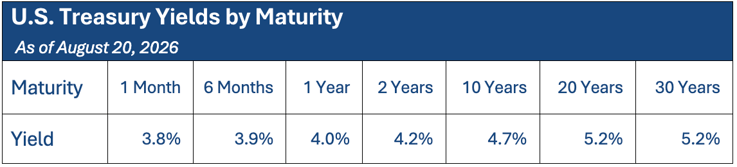
As of August 20, Treasury yields ranged from roughly 3.8% on short-term Treasury bills to approximately 5.2% on 20-year and 30-year Treasuries. The 2-year Treasury was around 4.2%, while the 10-year Treasury was approximately 4.7%. This is a relatively normal, upward sloping shape for the yield curve.
Today's Rates Are Not Historically Unusual
While the current 2-year Treasury yield of ~4.2% is significantly higher than the ~0.1% yields available during the pandemic-era, the current yield is not particularly unusual when viewed against the longer history of interest rates.
Following the Global Financial Crisis, the Federal Reserve kept interest rates extraordinarily low and purchased large quantities of bonds. These policies pushed both short- and long-term borrowing costs lower. The pandemic continued that trend, with short-term rates effectively reaching zero.
Today's rates therefore look high compared with the last 15 years, but they look much less unusual when compared with the broader history of the bond market. That distinction matters. Investors have become accustomed to unusually low interest rates, but unusually low rates are not necessarily the historical norm.
The Fed Controls the Short End of the Curve
To understand today's bond market, it is important to understand the distinction between short- and long-term interest rates.
The Federal Reserve primarily controls the short end of the yield curve through its target for the federal funds rate—the overnight rate at which banks lend to one another. Changes in the federal funds rate ripple through the economy, affecting credit cards, home-equity lines of credit, business loans, and other forms of borrowing.
When the Fed raises rates, borrowing becomes more expensive. This generally slows economic activity and reduces demand, which can help ease inflationary pressure.
Conversely, when the Fed lowers rates, borrowing becomes cheaper. This can encourage consumers and businesses to borrow and spend more, supporting economic activity but potentially increasing inflationary pressure.
The important point is that the Fed does not directly control the 10-year or 30-year Treasury yield. Those rates are determined by the bond market.
The Long End of the Curve Is Telling Us Something
The 10-year Treasury yield is heavily influenced by market expectations for inflation, economic growth, Treasury borrowing needs and the supply and demand for bonds.
One useful comparison is the relationship between the 10-year Treasury yield and long-term inflation expectations.
The University of Michigan's latest survey shows long-run inflation expectations at approximately 3.3%, above the Federal Reserve's 2% inflation target. At the same time, the 10-year Treasury yield is approximately 4.7%. That leaves investors with a nominal yield roughly 1.4 percentage points above long-term expected inflation.
That spread may not be sufficient if inflation remains stubbornly above the Fed's 2% target. If investors become convinced that inflation will remain elevated for longer, they may demand higher yields on long-term bonds.
The Supply of Bonds Is Also Increasing
There is another fundamental issue facing the bond market: supply.
The federal government continues to run large budget deficits and must issue Treasury securities to finance those deficits. The Congressional Budget Office (CBO) currently projects a $1.9 trillion federal budget deficit for fiscal 2026, or approximately 5.8% of GDP.
The basic economics of supply and demand suggest that if the supply of bonds increases substantially, investors may require higher yields to absorb that supply—particularly when other borrowers are competing for the same capital.
AI Is Creating Another Major Source of Borrowing Demand
The artificial intelligence boom is being fueled by enormous capital expenditures from major hyperscalers, including Microsoft, Alphabet, Meta, and Amazon. Much of this investment is being funded from operating cash flow, but the companies are also increasingly accessing the debt markets.
Reuters has reported that the major hyperscalers have issued more than $220 billion of bonds this year, roughly double the prior year's amount, with corporate bond issuance expected to remain elevated as AI infrastructure investment continues.
More broadly, the scale of AI investment is enormous. A recent Wall Street Journal analysis estimated that the major technology companies have approximately $3 trillion of additional off-balance-sheet commitments associated with AI infrastructure, including future leases and purchase commitments.
The bond market is beginning to pay closer attention to this spending. As one example, Alphabet has a 5.70% bond maturing in 2075. That bond has recently traded at a price well below par, pushing its yield to roughly 6.5%–6.7%. This matters because governments and corporations are competing for the same pool of global capital.
The Treasury Is Responding
The Treasury is not ignoring the rise in long-term interest rates. On August 19, it announced at least a doubling of the maximum size of its long-end liquidity-support buyback operations, increasing them from $2 billion to $4 billion or more per operation. The purchases focus on longer-dated Treasury securities in the 10-to-30-year sectors.
The announcement initially helped push yields lower, but the effect was short-lived. The 30-year Treasury yield reached ~5.31% on August 17. Following the Treasury's announcement, yields temporarily declined before moving higher again. On August 21, the 30-year yield was approximately 5.28%.
This is an important signal. The Treasury can influence the market, but it cannot dictate where long-term interest rates ultimately settle. Investors determine the price of Treasury securities based on their expectations for inflation, economic growth, fiscal policy, supply and demand, and the return available on competing investments.
What Does This Mean for Investors?
For investors, today's bond market presents both opportunities and risks.
1. Enjoy the higher rates
For the first time in many years, investors can earn meaningful yields without taking substantial credit risk. Short-term Treasury bills are yielding around 3.8%–3.9%, while longer-term Treasuries offer yields above 5%. Saving money is finally rewarding again.
2. Understand that interest rates affect stocks, too
Higher interest rates also affect equity valuations. As interest rates rise, future cash flows become less valuable when discounted back to today's dollars. Higher rates can therefore put downward pressure on price-to-earnings multiples, particularly for companies whose valuations depend heavily on earnings expected many years in the future.
Higher borrowing costs can also slow economic growth and make it more expensive for companies to finance expansion. This is particularly relevant today given the enormous capital requirements associated with the AI buildout.
3. Know what you own in your fixed-income portfolio
Not all bonds carry the same risk. Investors should understand:
- Is the bond investment grade?
- How strong is the issuer's balance sheet?
- Does the company generate enough cash flow to service its debt?
A 5% Treasury and a 7% corporate bond are not equivalent investments. The corporate bond is offering additional yield because the investor is taking additional credit risk. That additional yield may or may not adequately compensate for the risk.
4. Know which companies can finance themselves
When evaluating companies, investors should ask: Can this company fund its growth internally, or does it need to continually access the debt markets?
A company generating substantial free cash flow has considerably more flexibility when interest rates are high. A company that needs to continually issue debt to fund capital expenditures, acquisitions or operating losses becomes increasingly vulnerable when borrowing costs rise.
This doesn't necessarily mean investors should avoid companies that borrow money. Debt can be an efficient source of capital, particularly for financially strong businesses. However, the ability to self-finance becomes increasingly valuable when the cost of external capital rises.
The Bottom Line
The recent headlines surrounding the bond market may make today's environment appear unusually alarming. But the underlying picture is more nuanced.
Treasury yields are higher than they were during the pandemic and higher than they were for much of the post-financial-crisis period. However, today's rates are not historically extreme. The yield curve is upward sloping and appropriately compensates investors for taking additional duration risk.
For investors, that means we should not fear higher rates simply because they are higher than they have been in recent memory. Instead, we should recognize that higher rates create both opportunities and risks.
For bond investors, higher yields provide an opportunity to lock in attractive income—provided the underlying credit and duration risks are appropriate.
For equity investors, higher rates make valuation and balance sheet strength increasingly important.
The recent volatility in bond yields underscores basic investing principles: know what you own, understand how it is financed, and don't assume that the era of extraordinarily cheap capital will return.
For informational purposes only. The information is not intended to provide specific advice or recommendations, and all investments involve risks, including the loss of principal.
Carnegie Investment Counsel (“Carnegie”) is a registered investment adviser with the Securities and Exchange Commission. Registration as an investment adviser does not imply a certain level of skill or training. For a more detailed discussion about Carnegie’s investment advisory services and fees, please view our Form ADV and Form CRS by visiting: https://adviserinfo.sec.gov/firm/summary/150488.
You may also visit our website at: https://www.carnegieinvest.com.