Nonprofit Investment Management Blog

Not All Investment Managers Are Fiduciaries. Does Your Board Know the Difference?

Posted by Skye Barry, CFA, CFP on Sep 1, 2026, 9:00:03 AM

If you sit on a nonprofit board or finance committee, you've probably heard the word "fiduciary" used to describe an advisor. What often gets missed is that your board already carries fiduciary responsibility, with or without an advisor in the picture.

This distinction matters more in the nonprofit space than almost anywhere else in personal or institutional finance because the money your board oversees isn't personal wealth. It's donor-restricted, mission-restricted, and entrusted to your organization by people who expect it to be stewarded responsibly. That raises the stakes on transparency, prudence, and oversight in a way that a typical investment conversation often doesn't capture.

Read More

Topics: Fiduciary, Nonprofit Investment Strategy, Nonprofits

What Nonprofits Think Is Normal From Their Investment Advisor, But Definitely Isn't

Posted by Megan Lencoski on Aug 19, 2026, 9:15:00 AM


If you've ever waited weeks for a simple account statement, or been told you couldn't access your own organization's money, you might assume that's just how it goes with investment advisors. It's not, and we want you to know that your organization shouldn't be treated like that.

Read More

Topics: Nonprofit Investment Strategy, Operations & Governance

The Hidden Cost of Playing It Safe with Nonprofit Funds

Posted by Skye Barry, CFA, CFP on Jul 28, 2026, 10:07:21 AM


There’s a myth in the nonprofit world: parking cash in a savings account is the “safe” choice. In reality, it can be one of the costliest decisions a board makes, and often the one no one thinks to question.

That doesn’t mean the market is always “safe” either. Investing always carries risk, including the risk of loss. But holding everything in cash carries a cost too, even if it never shows up on a statement. The question your board actually needs to answer isn’t which option is risk-free, because neither one is. It’s whether your decisions are intentional, and tied to what each dollar is actually meant to do.

Read More

Topics: Nonprofit Investment Strategy

Received an Endowment Gift? What to Do Next

Posted by Megan Lencoski on May 28, 2026, 10:10:47 AM

Receiving an endowment gift is a milestone. It signals that a donor believes in your mission enough to fund it, permanently. But that check arriving is the beginning of a serious set of responsibilities, not the end of the conversation. And many nonprofit leaders are not handed a roadmap when it happens.

Read More

Topics: Risk Management & Compliance, Nonprofit, Nonprofit Investment Strategy, Operations & Governance

Who's Holding Your Nonprofit's Assets? What a Third-Party Custodian Does and Why It Matters

Posted by Megan Lencoski on May 14, 2026, 9:00:01 AM

A well-governed nonprofit investment program should have more than good returns and a solid IPS. It has independent checks built into the structure, so no single firm has unchecked control over both the management and the holding of your assets. Understanding how third-party custody works is one of the cleaner ways a board can strengthen its oversight without adding complexity.

Read More

Topics: Risk Management & Compliance, Nonprofit, Nonprofit Investment Strategy, Operations & Governance

Should My Nonprofit Start an Endowment? 4 Considerations

Posted by Richard Westerfield on Apr 30, 2026, 12:23:38 PM

Your nonprofit needs secure funding to power your programs, and it might be time to consider your financial future beyond the traditional annual giving cycle. An endowment is an excellent option for nonprofits of all sizes to establish long-term financial stability.

An endowment is a pool of assets established by charitable contributions and invested by nonprofits to provide long-term, sustainable financial support for its mission or specific programs, often as defined by the donor(s).

For example, a donor might establish a scholarship endowment at a university. Rather than spending the principal, the university would distribute a portion of the endowment’s accumulated investment earnings each year to pay for students’ education.

However, while endowments can offer perpetual funding, they also come with certain limitations and requirements, meaning nonprofits should carefully consider whether their organization is prepared to properly steward and operate one. This article will review the top four considerations your organization should assess before deciding whether to start an endowment.

Read More

Topics: Risk Management & Compliance, Nonprofit, Nonprofit Investment Strategy, Operations & Governance

Common Mistakes Nonprofits Make With Their Investment Policy Statement

Posted by Skye Barry, CFA, CFP on Apr 24, 2026, 9:30:38 AM

A good investment policy statement(IPS) should make investment decisions easier, not harder. It should give your board clarity, protect your organization, and hold up under scrutiny.

Most nonprofits have an IPS. Not all of them have one that's actually doing its job. In our work with nonprofit organizations, we see the same problems come up again and again: documents that are outdated, too vague to be useful, or simply disconnected from how the organization actually operates.

None of these are catastrophic on their own, but they add up. And when a difficult market or a board transition arrives, a weak IPS is the wrong time to find out.

Here are the most common mistakes we see, and what to do about them.

Read More

Topics: Risk Management & Compliance, Nonprofit, Nonprofit Investment Strategy, Operations & Governance

Managing Restricted Funds and Endowments: The Do’s and Don’ts

Posted by Darryl Gecelter on Jan 28, 2026, 10:26:09 AM

For nonprofit leaders, CFOs, and finance committees, balancing liquidity with donor intent can be a constant challenge. Restricted funds and endowments often represent some of an organization’s most important and most sensitive assets.

Responsibly managing restricted funds and endowments secures donor trust and helps you avoid regulatory scrutiny. Errors in tracking, commingling, or investing these dollars inappropriately, on the other hand, can trigger compliance issues under ASC 958 or the Uniform Prudent Management of Institutional Funds Act (UPMIFA), as well as reputational damage that can take years to repair.

Proper stewardship requires clear policies, rigorous tracking, and financial infrastructure designed for restricted fund management. Below, you’ll find some of the essential dos and don’ts of managing restricted funds and endowments effectively.

Read More

Topics: Nonprofit, Nonprofit Investment Strategy

The UPMIFA 7% Rule Explained: What Nonprofit Boards Should Know

Posted by Megan Lencoski on Jan 22, 2026, 10:00:00 AM

Endowment spending decisions are rarely about the number alone. Board members and nonprofit leaders are responsible for supporting today’s programs while safeguarding resources for the future, which means multiple factors must be considered when setting a withdrawal rate. 

Read More

Topics: Nonprofit, Nonprofit Investment Strategy

When Should My Nonprofit Hire an Investment Advisor?

Posted by Megan Lencoski on Jan 8, 2026, 11:05:07 AM

For many nonprofits, the question isn’t if professional investment guidance will be helpful; it’s when. 

Early on, managing reserves and small investment accounts internally may feel manageable. But as assets grow, donor generosity increases, and boards ask more thoughtful questions, the responsibility around stewardship naturally becomes more complex. 

So how do you know when it’s time to partner with an investment advisor? 

This post walks through the common signs nonprofits experience as they grow, along with what an advisor can help with and how to choose the right one.  

Read More

Topics: Nonprofit, Nonprofit Investment Strategy

  • There are no suggestions because the search field is empty.

nonprofit-download-hubspot

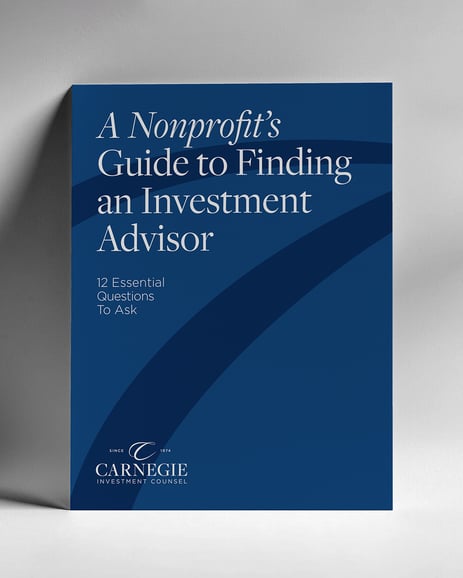
Looking to hire a Financial Advisor for your nonprofit?

Finding the right investment advisor shouldn't be difficult.

In this easy, two-page guide, we walk you through the key questions you should ask when evaluating investment advisors for your organization. Here's what you'll learn: 
  • Key questions to ask potential advisors
  • How to compare different investment advisors
  • The importance of a personalized investment strategy
  • What additional, value-added services your advisor should offer you

Download Now, It's Free and Helpful!

Recent Nonprofit Articles

Subscribe here for monthly blog updates!