Accepting non-cash assets can unlock a whole new pool of donors, yet many nonprofits still rely entirely on credit cards, cash, and checks. This reliance leaves transformational funds on the table and limits your organization’s long-term sustainability.
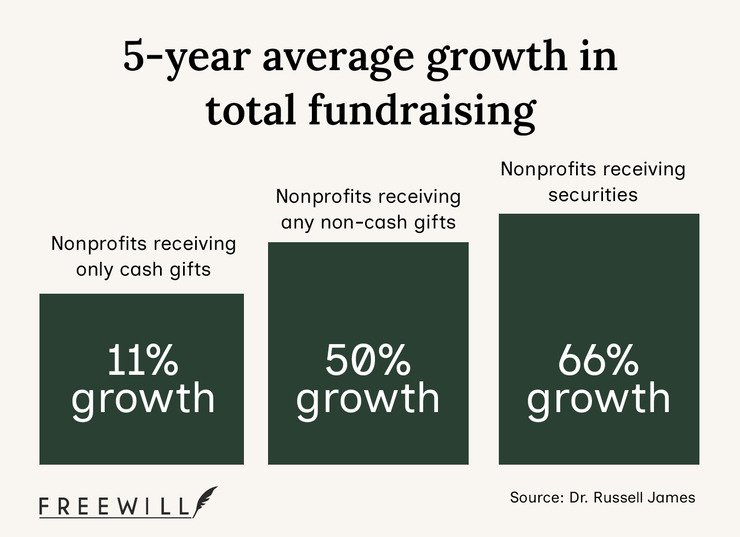
In fact, research shows that organizations accepting complex assets grow their overall revenue much faster than cash-only nonprofits. According to a landmark study by Dr. Russell James, nonprofits that accepted only cash gifts experienced an average 11% increase in contributions over five years, barely keeping up with inflation. Meanwhile, those accepting any non-cash gift experienced 50% growth, and those accepting appreciated securities (like stock and real estate) experienced 66% growth.
Accepting non-cash gifts is a win-win for both parties: they often generate larger gift sizes, can offer excellent tax incentives for donors, and diversify your revenue. To help you capture major gifts and build sustainable revenue, let’s explore tax-smart giving options like stocks, QCDs, DAFs, and cryptocurrency.
1. Stocks and Securities
Appreciated stock is one of the most mutually beneficial ways for your supporters to give. The primary motivation for donors is clear: by donating appreciated securities (held for more than a year), they can often avoid capital gains tax and may be able to claim a charitable deduction for the full fair market value (FMV).
Want to learn more about how to accept and attract gifts of stock to your nonprofit? Check out our guide, How Stock Donations Can Skyrocket Nonprofit Fundraising, and our recorded webinar, Unlocking Stock Gifts: A Toolkit for Nonprofits.
FreeWill’s guide to stock donations highlights these three types of stock donations to know:
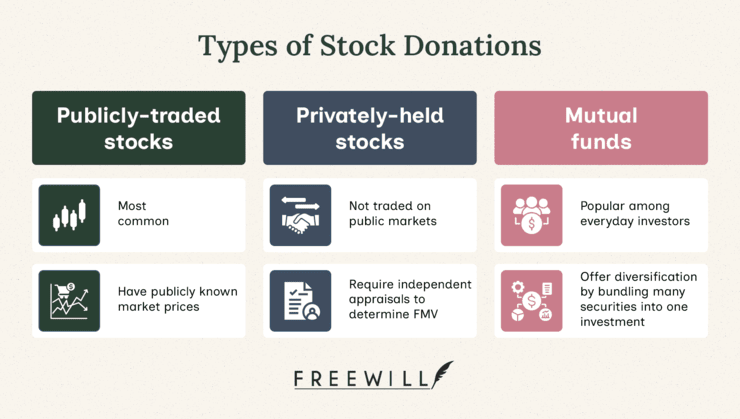
- Publicly-traded stocks: These are shares of companies actively traded on public exchanges, such as Nasdaq or the NYSE. Because their value is public and highly liquid, they are the most common and straightforward type of security for organizations to accept and sell.
- Privately-held stocks: These shares belong to companies that are not publicly traded and are typically owned by a small group of founders, employees, or private equity firms. They require independent appraisals to determine their Fair Market Value (FMV).
- Mutual funds: These risk-mitigating funds are a highly popular option among everyday investors. They offer diversification by bundling many different securities into one single investment.
To get started accepting gifts of stock, watch our video: How Nonprofits Can Accept and Attract Gifts of Stock. We go into more depth in the video, but in simple terms, you’ll need to:
- Open a brokerage account
- Determine your process
- Let your donors know
2. Qualified Charitable Distributions
As of 2026, a qualified charitable distribution (QCD), frequently called an IRA Charitable Rollover, allows donors aged 70½ or older to transfer funds directly from their IRA to an eligible 501(c)(3) organization. For 2026, eligible individuals can transfer up to $111,000 directly to a charity.
This giving vehicle yields major gifts drawn from a donor's lifetime retirement savings rather than their standard checking account. Here is why QCDs can be a highly strategic giving option for your supporters and your nonprofit:
- Satisfies RMDs and reduces taxable income: As of 2026, for donors 73+or 75+ (the onset of RMDs are based on year of birth), a direct QCD transfer can count toward their required minimum distribution (RMD). Because the funds go directly to the charity, the amount is excluded from the donor's adjusted gross income (AGI).
- Prevents tax surcharges: By keeping their adjusted gross income lower, donors can prevent being bumped into a higher tax bracket or facing higher Medicare premiums.
- Encourages reliable revenue: Because IRA owners must satisfy their RMDs annually, your nonprofit can steward these supporters into reliable, recurring major donors.
The latest research on QCDs shows that nonprofits that promote this giving vehicle at least 4 times throughout the year are more likely to raise $100,000+ through QCDs. In terms of timing, nearly 7 in 10 organizations reported QCD gifts peak at the end of the year, making them perfect to highlight in your year-end appeals.
3. Grants from Donor-Advised Funds
Donor-advised funds (DAFs) represent the fastest-growing segment in philanthropy today. That makes them a great addition to your nonprofit’s development strategy!
DAFs act as charitable investment accounts in which donors contribute to an investment fund that’s managed by a sponsoring organization. Beyond cash, donors can also contribute non-cash assets, such as stocks and cryptocurrency. The DAF’s sponsor then manages and invests those assets, and donors can recommend grants at a later date.
Essentially, donors receive a tax deduction when they contribute to their account and are simply waiting to recommend grants to specific charities. Because these funds cannot be returned to the donor, supporters treat them as money they’ve already set aside to give, making them highly responsive to solicitations.
To capture these grants, you can build momentum by fostering relationships with both DAF donors and their sponsoring organizations. Next, find a digital tool that helps facilitate the giving process for your donors. You can then maximize awareness by making direct solicitations to major donors, adding clear instructions to your website’s Ways to Give page, and incorporating DAF messaging into your year-end appeals and major giving outreach. When a donor recommends a DAF grant, your nonprofit receives the funds directly from the sponsoring organization via check or electronic transfer.
4. Retirement Account Beneficiary Designations
One of the simplest planned gifts a supporter can make doesn't require a check, a will, or an attorney. Donors can name a nonprofit as the beneficiary of retirement assets such as IRAs, 401(k)s, 403(b)s, and pensions, often by completing a single form with their account custodian or plan administrator.
For donors who plan to leave both family and charity in their estate, retirement accounts can be one of the most tax-efficient assets to direct to a nonprofit. According to the IRS, beneficiaries must generally include taxable distributions from an inherited traditional IRA or retirement plan in their gross income. Since the SECURE Act, most non-spouse beneficiaries must also withdraw the full balance within 10 years, which can compress that tax liability into a shorter window. A qualified 501(c)(3), by contrast, is generally exempt from federal income tax, which means the full distribution may be available for your mission.
Here's why beneficiary designations can be a smart addition to your planned giving program:
- Accessible to donors at many giving levels: Donors don't give up anything during their lifetime, so supporters who may not be in a position to make a major gift today can still make a meaningful future commitment.
- Flexible for donors: Because donors keep full control of their accounts and can update their beneficiaries at any time, this option appeals to supporters who want to plan ahead without locking in a decision.
- Separate from the will: Beneficiary designations can pass outside of probate and are often governed by the account's beneficiary form rather than the donor's will, so the process can be more straightforward for everyone involved.
Keep in mind that because these designations can be changed, they are best treated as a planned gift expectancy rather than guaranteed future revenue. Encourage donors to let your team know when they've named your organization so you can thank them, steward the relationship, and plan accordingly. To make the process easier, include your organization's full legal name, address, and EIN on your Ways to Give page, and remind supporters to consult their financial, tax, or legal advisors before updating their designations.
5. Life Insurance Policies
Life insurance gifts offer another way for supporters to make a gift that may be much larger than what they could give in cash during their lifetime. There are two common ways donors can give through life insurance, and the tax treatment differs between them.
- Naming your nonprofit as a beneficiary: A donor can designate your organization to receive all or a portion of a policy's death benefit while keeping ownership of the policy. This approach is simple and flexible, since the donor can change the beneficiary later. Because the donor keeps ownership and control, this arrangement generally does not qualify for an income tax charitable deduction during the donor's lifetime.
- Transferring ownership of the policy: A donor can irrevocably transfer ownership of a policy to your organization, naming it as both owner and beneficiary. According to IRS Publication 526, a donor generally can't deduct a contribution of less than their entire interest in property, so the donor must give up all rights in the policy for the gift to potentially qualify for a deduction. The deductible amount depends on the policy's value and the donor's cost basis, and premiums the donor pays after the transfer may also be deductible. Donors should work with their tax advisor to understand how these rules apply to their situation.
Before accepting ownership of a policy, your team should review a few practical questions:
- Are premiums still due, and who will pay them?
- What happens if payments stop and the policy lapses?
- Does the policy have cash value your organization could access?
Your gift acceptance policy should spell out how your organization evaluates these gifts.
Nonprofits should also steer clear of any arrangement in which the organization pays premiums on a policy that benefits the donor or their family. The IRS specifically notes that contributions connected with these types of split-dollar insurance arrangements are not deductible, and they can create compliance risks for your organization.
Accepting Non-Cash Gifts Can Grow Your Revenue Streams
At the end of the day, building a strong fundraising strategy means meeting your donors where their actual wealth lives: outside of their checking accounts. By opening the door to gifts of stock, IRAs, DAFs, retirement account beneficiary designations, and life insurance policies, you make it easier for supporters to make a lasting impact on your mission.
If you're wondering where to start, take the time to create or refresh your gift acceptance policy. Think of it as a helpful roadmap for your team: it keeps everyone aligned and protects your nonprofit from taking on assets that might cost more to manage or sell than they're actually worth.
With a few clear guidelines and the right tools in place, your organization will be ready to step outside its fundraising comfort zone and accept non-cash gifts.